Showing posts with label HRMPO. Show all posts

Wednesday, April 29, 2009

HRPDC and HRMPO Spring 2009 Publications available

Hampton Roads Planning District Commission's "Hampton Roads Review" Newsletter, Spring 2009

www.HRPDC.org

In this issue:
  • Hampton Roads H2O – Help to Others – Program
  • Regional Water Supply Plan
  • HR CLEAN Brings Regional Attention to Plastic Bag Litter
  • Localities Gather Data, Assess Sanitary Sewer System
  • Climate Change Impact Study Underway
  • Updating the Regional Green Infrastructure Network
  • Hampton Roads Watershed Roundtable Holds Green Building Meeting
  • Regional Pollution Prevention Training Spurs Local Actions
  • Bacteria TMDL Status (Total Maximum Daily Load)
  • Build-Out Scenarios Studied for Northwest River
  • American Recovery and Reinvestment Act of 2009: A Hampton Roads Perspective
  • HRPDC Joins Regional Task Force on Ending Homelessness
  • Region to Host 2009 VA Association of Housing Counselors (VAHC) Conference
  • Update on the Hampton Roads Labor Market
  • Proposed State Budget Cuts Dissolve Disability Service Boards
  • Rural Long Range Transportation Plan (RLRP) Public Meeting Held
  • FEMA Region III Administrator Visits the Regional Emergency Management Technical Advisory Committee (REMTAC)
  • Moving Towards a Regional Capability Assessment, Evaluates Readiness Level of Emergency Management and Homeland Security
  • Debris Management – Filling the Gaps
  • Healthcare Organizations Emergency Preparedness Seminars (HOEPS): Survive and Thrive 2009!

Hampton Roads Metropolitan Planning Organization's "Crossings" Newsletter, Spring 2009

www.HRMPO.org

In this issue:
  • Letter from the Hampton Roads Transportation Technical Committee Chair Jeffrey K. Raliski, AICP
  • Navigating the Future of the Region's Transportation System
  • Chesapeake Regional Airport Terminal Opens Expansion
  • VTrans2035-Continuing the Journey (Commonwealth’s statewide transportation plan)
  • HRMPO Holds Annual Retreat: A Successful Step toward Regional Cooperation
  • Transportation Funding for Hampton Roads in the American Recovery and Reinvestment Act of 2009
  • HRMPO Selects Local Projects to Receive $41 Million in ARRA Funds
  • Draft Transit Vision Plan for the Region Released
  • The State of Transportation in Hampton Roads UPDATE
  • Roadway Travel in Hampton Roads Decreased in 2008

Tuesday, April 14, 2009

Navigating The Future: Hampton Roads 2034 Long-Range Transportation Plan


GET INVOLVED-Take a survey! The Hampton Roads Transportation Planning Organization (formerly known as the Metropolitan Planning Organization) is looking for your vision of the region’s transportation system. Click the banner or link above to take the survey.

In accordance with federal regulations, the HRTPO produces a financially constrained Regional Long-Range Transportation Plan (LRP) every four years that addresses a planning horizon of 20 years. The purpose of these plans is to guide transportation investments to projects designed to meet the transportation goals of the HRTPO--economic vitality, safety, mobility, and environmental protection.

Be part of the plan!

Tuesday, March 31, 2009

A Voice for Hampton Roads

by James F. Babcock

“Who Speaks for Hampton Roads?”

This excellent question, raised by Louis Guy in a Virginian-Pilot (V-P) Dec. 27, 2008 op-ed, is especially pertinent now as the region faces a perennial crisis in transportation funding, the possible loss of an aircraft carrier, a decline in tourism, a weakened economy, and budget cuts all around.

The answer is, “No one entity ─ it depends on the issue.” Numerous private regional associations exist to speak out for particular interests: the Retail Alliance for retailers, HRACRE for commercial realtors, the Chambers of Commerce for business in general, the Cultural Alliance for the arts, and so on.

On public issues, however, where the right to answer for the general public depends on legitimacy conferred by election, the only regional organizations that can speak for the region are those in which the region’s legislators or its mayors and county chairs serve. These include the Legislative Caucus, Planning District Commission, Metropolitan Planning Organization, Mayors & Chairs Caucus, and Hampton Roads Partnership.

Each of these entities was created at a different time for a particular limited purpose. None can be said to do an especially effective job of involving the public in its decision making. And each suffers limitations that would not apply, say, to a full-blown regional government, which the public doesn’t want. As a result, as Mayor Paul Fraim observed in his year-end V-P op-ed, “No one is in charge.”

Over the past few years, the Future of Hampton Roads, a volunteer organization, through its Regional Structure Project, has sponsored conferences and study groups to produce thoughtful recommendations for improving the performance of these regional organizations without either merging our municipalities or creating a regional government. Detailed reports have been submitted in the past year to the Metropolitan Planning Organization, Hampton Roads Partnership, and Mayors & Chairs.

One study group report soon to be submitted to the elected leadership specifically deals with the urgent need identified by Mr. Guy to create an authoritative voice for Hampton Roads. Based on successful regional models elsewhere (Metro-Dade, Twin Cities Metro, etc.) but adapted to our region’s unique circumstances, the recommendation is to obtain a state charter for a Hampton Roads Metropolitan Council.

The proposed Metro Council would undertake key tasks not now being performed. It would:
  • oversee the regional aspects of economic and tourism development;
  • direct periodic updating of a comprehensive regional vision;
  • coordinate preparation of an annual regional legislative agenda; and
  • strengthen regional decision-making.
Supported by Planning District Commission staff, the proposed Metro Council would establish working relationships with the other regional organizations. For example, an updating of the regional vision every five to seven years might best be performed on behalf of the Council by the Hampton Roads Partnership. Also, the Council could engage the Hampton Roads Center for Civic Engagement to assist in creating essential public participation in basic decisions.

An alternative to creating the Council might be to refashion one of the present regional organizations. In any case, having a Metro Council with definite power to make decisions on a short list of key regional issues would provide a vehicle for more assertive regional leadership and to fill the present gap in high level policy formulation.

The huge challenges the region now faces warrant serious attention to implementing this structural improvement. We should accept Louis Guy’s advice. Let’s get organized.

Mr. Babcock, retired Chairman and CEO of First Virginia Bank Hampton Roads, is a founding member of the Hampton Roads Partnership, Vice Chairman of the Future of Hampton Roads, Inc. (FHR) and manager of FHR’s Regional Structure Project, whose reports are posted on http://www.fhrinc.org.

A citizen speaks: WE WANT MASS TRANSIT AS A SOLUTION

by Troi Lewis, a public transit evangelist, City of Hampton resident and frequent online commenter and forum participant; Troi is looking forward to the day when he can use public transportation all the time.

Currently, we need to realize a cost effective alternative to the transportation issue. While it is true that new tunnels and roads are needed, it is still in our best interest to implement mass transit. If you don't agree, please consider the following: Whatever decision is made, it has to be paid for somehow.

I say this because there are concerns as to the cost of the starter light rail (LRT) line in Norfolk. There's also concern about Virginia Beach’s purchase of the remainder of the Norfolk Southern (NS) line to eventually bring LRT to the Beach. But the truth of the matter is: it's the start to an alternative.


Notice that it's called a "starter line". It's not called the "only line", or "Norfolk's exclusive-customized-one-of-a-kind-light rail line; it's called a "starter line". It's the beginning to a light rail system that could stretch all over Hampton Roads and beyond. You probably would also say: This doesn't seem cost effective.

On the contrary, compared to what a new tunnel or crossing would cost, piecing together a light rail system with Bus Rapid Transit (BRT) and Street Car systems would be a lot less. No matter the cost, we need something that would bring a lot more to the table then just more tunnels and more roads.

If you look at TOD (Transit Oriented Development) as something that only feeds the developers’ pockets, you’re not looking at the big picture. Look at the convenience of having some form of rapid transit within walking distance of where you live, work, shop, school, etc. While interstates and expressways are good for business and those close to them, they don't bring property value up like rail or rapid transit does.

There's also a very large financial return that comes from TODs. This could help fund other transportation projects.

You also need to think about the environmental effect this can have, specifically on our health. Think of your children and your other loved ones that have asthma, allergies, or any other forms of respiratory problems.

So I say to you Hampton Roads: Support your city and their decision to bring mass transit (whatever the form) to the region. This will be supporting all of Hampton Roads.

The General Assembly (GA) is not providing solutions. The MPO has worked on bringing a solution to the traffic and travel time through this Plan: www.HamptonRoadsTransitPlan.com


Again, many of the cities are already working on implementing these ideas. So it's going to take all of Hampton Roads to come together to make this into a reality. For those of you who agree on these ideas, please, PLEASE show that you are in support of what's being planned. This way the GA will see that something like this needs to be funded and not put on the back burner like it has been for the past 20 years. I, myself, would rather pay taxes for something that I know can actually bring benefit and make a change, then for something that will be outdated before it's even finished.

So, in closing, we have to put our voices together on this one and tell the GA: WE WANT MASS TRANSIT AS A SOLUTION!!!!

Friday, March 20, 2009

Transit Vision Plan's Public Presentation

Scroll through this presentation for Vision Maps to see how this long-range plan affects your future, your life, your work, your mobility:
Transit Vision Plan for Hampton Roads with Maps

View this presentation in a new browser window; click on "Full" to view full screen; click on "Download" to download the presentation to your own computer.


The Hampton Roads Metropolitan Planning Organization (HRMPO) is undertaking an effort to develop a regional vision of public transportation, indicating the combination of transit services and land use intensity best suited for the region. The basic premise of this study is that public transportation provides a mobility option valuable to the individuals who use it and beneficial to the whole community as part of its economic infrastructure. Route-based public transportation services are generally financially feasible where they connect high activity locations.

This plan is being conducted at the request of the Virginia Department of Rail and Public Transportation (DRPT) and will be used as input into the Hampton Roads component of the Virginia 2035 Statewide Transit Plan.

Authored by the consultant team of HNTB Corporation, Vanasse Hangen Brustlin Inc., RLS and Associates Inc., and Travesky & Associates Ltd. with cooperation from staff from the Hampton Roads Metropolitan Planning Organization, funding from the Virginia Department of Rail and Public Transportation, and sponsorship by the Hampton Roads Partnership.

More on the Transit Vision Plan plus a link to the complete Draft Plan.

Friday, February 13, 2009

HRPDC, HRMPO publications

Get the recent publications from the Hampton Roads Planning District Commission and Metropolitan Planning Organization:


Thursday, February 12, 2009

TRANSIT VISION FOR THE HAMPTON ROADS REGION (draft)


For information on public meetings to be held in Hampton and Norfolk on February 24th, visit: www.HamptonRoadsTransitPlan.com


TRANSIT VISION FOR THE HAMPTON ROADS REGION
Hampton Roads is to be served by an efficient, sustainable, and integrated transit network of local buses, express buses, bus rapid transit, light rail transit, and commuter rail. Local buses serve neighborhoods and link riders to higher capacity transit corridors. The light rail system, the streetcars, and the bus rapid transit lines provide fast and reliable regional transit connections. Commuter rail carries workers across the longer distances from semi-rural residential areas to employment and activity centers in the region. As a result of its transit investments, the region continues to attract employers, residents, and visitors, and it continues to grow and foster economic development. However, this growth is compact – primarily targeted to mixed-use activity centers and high-capacity transit corridors – and better protects the region’s precious natural resources and environmentally sensitive areas. Ultimately, the region’s pattern of growth increases mobility, accessibility, and quality of life — allowing a parent to walk a child to school, step into a café for breakfast, then walk to the transit station for the morning’s commute.

Download the complete plan draft HERE.

Authored by the consultant team of HNTB Corporation, Vanasse Hangen Brustlin Inc., RLS and Associates Inc., and Travesky & Associates Ltd. with cooperation from staff from the Hampton Roads Metropolitan Planning Organization, funding from the Virginia Department of Rail and Public Transportation, and sponsorship by the Hampton Roads Partnership.

The process to develop this integrated Transit Vision Plan was initiated by the Hampton Roads Partnership. Joining with the Hampton Roads Metropolitan Planning Organization (HRMPO) and the Virginia Department of Rail and Public Transportation (DRPT), a study was launched with the establishment of a Public Transportation Plan Technical Committee (PTPTC), made up of jurisdictional staff and representatives from the HRMPO, DRPT, Hampton Roads Transit, and the Hampton Roads Partnership.

Can today be another turning point in our MPO story?

HRMPO Retreat Remarks, 11 Feb 09, by Jim Oliver, Chair of the Hampton Roads Center for Civic Engagement (HRCCE) and retreat facilitators:

Can you imagine a total new beginning, a fresh start, as well as an agenda for reform?

Neither sleet, snow, Dillon Rule, nor state or federal money shortages kept you from success. Just think of the remarkable stories---new Town and High Street in James City and Williamsburg---Yorktown development, Power Plant in Hampton, Newport City Centre, MacArthur Mall, Town Center, Harbor Center, Victory Crossing, VMASC---to name a few.

This is clearly collaborative work that goes beyond the boundary lines of localities.

The MPO is a public body that is a product of federal law. The use of federal dollars for transportation requires regional decision-making. It must adhere to Virginia Laws, such as the Freedom of Information and Public Procurement Acts. For the good of each jurisdiction and for the region, this is very important work.

Monday, February 2, 2009

HRMPO 101 on WhatMatters.TV

What is the HRMPO? The Hampton Roads Metropolitan Planning Organization is the intergovernmental transportation planning body for thirteen jurisdictions in Hampton Roads. If you’ve ever been worried about traffic tie-ups in Hampton Roads and you’ve wanted to know how you can find out about the planning process, then you should know about the HRMPO.

Recently, "What Matters" host Cathy Lewis spoke with HRPDC/HRMPO Executive Director, Dwight Farmer; HRPDC/HRMPO member and Newport News Mayor Joe Frank; and Virginia Beach Taxpayer's Alliance Chair, John Moss, for an in-depth look at this little known, federally-mandated, entity that has a major impact on the Hampton Roads transportation issue.


City of Newport News Mayor Joe Frank:
"...it doesn't appear that we're going to have substantial investment in new road programs for the foreseeable future and, I might add, if you had all the money you needed to do these things today, you'd be talking 10 to 15 years before all of the processes took place, the environmental studies, the acquisitions, the engineering studies and the construction so you could actually ride on those roads and then you have the question of what the population is going to be, what are the ridership, what are the needs."

"So, one of the things that I have suggested, and not through the PDC or the MPO, but through the Hampton Roads Partnership, is that they convene the leaders of the largest traffic generators in the region, the colleges, the universities, the military bases, the large manufacturers, the ship yards and so forth, to see if we couldn't voluntarily, because we have no legal basis for requiring it, voluntarily asking these people to consider staggering the times they open and the times they close. If, through that, and you model and simulate that in a very real time way...the data suggests that you could defer the need for all these new road projects for 10 or 15 years, and maybe by that time...you find a way to actually pay for what you've determined you actually need."


Original air date: Fri, Jan 30, 2009
See the complete show: http://www.whro.org/home/html/podcasts/whatmatters/144.mp4

Sunday, February 1, 2009

Newport News and HRMPO acting regionally

In a Daily Press article by Sabne Hirschauler on December 19, 2008, it was reported that the Hampton Roads Metropolitan Organization* voted to shift $3 million in Newport News light rail dollars to the city of Norfolk to cover current cost overruns as well as $1.5 million to Virginia Beach.

Newport News had approximately $10.2 million in federal grant money for its light-rail study, which would have paid for preliminary engineering reports and environmental studies. Because of Newport News’ slim chances to get light rail anytime soon, Mayor Joe Frank agreed to the shift of funds so it could be used for the region. This is a long-term vision for a regional light rail system for a regional metropolitan area.

According to online commenters: when southside cities of Norfolk and Virginia Beach have a functioning line, then the peninsula and Portsmouth should connect. Light rail would be successful region-wide because of its connectivity to a stable/viable light rail system. These things have to be done in order and in good measure.

* Federal regulations require that urbanized areas throughout the United States have a Metropolitan Planning Organization (MPO) to conduct a continuing, cooperative and comprehensive transportation planning process. Urbanized areas are defined as areas with a population of 200,000 or greater.

For the complete Daily Press article, click HERE.

Wednesday, November 19, 2008

Regional Transit Vision Plan


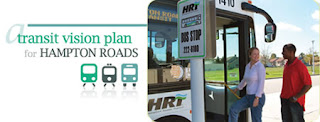
The time has come for a regional, long-range vision plan for bus and rail service for the Hampton Roads area. The Hampton Roads Metropolitan Planning Organization (HRMPO) is developing a regional vision of public transportation corridors and districts. The plan will outline the combination of transit services and land use best suited for each corridor and district.

A Public Information Meeting on A Transit Vision Plan for Hampton Roads was held October 16, 2008. All meeting materials are available at www.HamptonRoadsTransitPlan.com. Please check this out as well as further information about the study and sign up for future email updates.

Thursday, October 16, 2008

ODU Student and Hampton Roads Blogger reviews HRMPO Transportation Meeting


by Russell Manning
(including photo credit)
WVEC News 13 interviews meeting participants.

HRP’s Executive VP, Donna Morris, also in attendance, can be seen in the background.


Representatives from Hampton Roads Transit, Williamsburg Area Transit, VDOT, and other transportation specialists were on hand at the HRMPO Public Meeting. Speaker, Michael Townes, President/CEO of HRT, hit home with his message that now is the time for regional mass transportation action.

Mr. Townes believes that everyone should be able to choose their mode of transportation. Choice is an ‘American Value,’ and that, currently, if you don’t drive, you’re out of luck in Hampton Roads.

He said that HRT, while willing and able, is unable to increase frequency and duration of bus service due to reliance on funding from the cities.

Apparently Hampton Roads’ method of individual city payments to HRT is unique in that it is funded by property tax revenues, something not done anywhere else in the country. Transit Organizations elsewhere have a dedicated funding system, so that property owners do not pay the majority of money funding mass transit.

Mr. Townes also called HRT “an amazing success,” and, thanks to the cities’ support, Hampton Roads pays substantially less than other areas pay for similar services.

Vince Jackson, VP of Planning for HRT, spoke on land use, stating that for mass transit to work most effectively, every locality in Hampton Roads needed to work together to develop land use patterns that were less conducive to single occupancy vehicles and more conducive to mass transit.

Mr. Matthew Huston, engineer for HNTB, the planning firm responsible for the Transit Plan, spoke. Mr. Huston said that current development patterns were unacceptable for the future and made it difficult for planners to create effective mass transit solutions, pointing out that whatever the solution was, it had to be multi-modal.

Comments and questions followed with most comments referring to precisely what users would want in a mass transportation system: fewer transfers, longer hours of operation, and ease of use.

Russell, a junior in the Political Science major at ODU, was named by Hampton Roads Magazine as a Top Ten Blogger in the region, and we thank him for his insightful report. http://757HamptonRoads.blogspot.com