During breakfast, “
Be There, Be Counted” video vignettes were provided by WHRO’s Center for Regional Citizenship (CRC). A live internet connection was also provided to those who wished to view
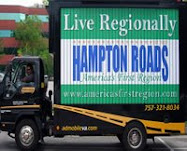
HamptonRoadsPerforms.org, the recently launched website that supplements current strategic planning and civic engagement efforts by focusing on regional performance. Designed to inform and engage citizens and community leaders in discussions about the future of Hampton Roads, information on the website answers the question, “
How is Hampton Roads Doing?” on a broad array of indicators, ranging from personal income to educational attainment and traffic congestion.
Jim Oliver, Chairman, and Betsy McBride, President, of HRCCE welcomed the approximately two hundred in attendance.
An Audio Address was shared from Bob O’Neill, Executive Director of the International City/County Management Association (ICMA), the membership organization dedicated to creating excellence in local government through professional management. (Bob is a former City Manager of Hampton.)
Bob said:
We find ourselves in “a time of turbulent change,” a time where we need to address how democracy works. Many issues matter, yet none can be addressed without proper public engagement. The need is great to reach across our political, municipal and geographical boundaries to make the most impact. The work we do now matters to the entire region’s future. It’s all about the possibilities.The rest of the event was moderated by Suzette Denslow: Chief of Staff for Richmond Mayor Dwight C. Jones and formerly with the Virginia Municipal League.
Suzette shared:
Civic engagement is the first step up from volunteerism. When we work together with respect, we move forward on our commonalities.
Keynote by Chris Gates: Executive Director of PACE, Philanthropy for Active Civic Engagement, a new organization founded to bring more attention and focus to the issues of civic engagement and to encourage more members of the philanthropic community to make civic engagement a part of their funding priorities. Previously served for 11 years as President of the National Civic League. A synopsis of Chris' remarks follow:
Why civic engagement? Hampton Roads as a region is an interdependence of communities. People know the moniker “Hampton Roads” around the country and are less apt to be able to name the individual cities and counties that make up the region.
To solve a problem, you must first recognize the problem, which leads us to list the greatest challenges for successful civic engagement:
- The Information and Technology Revolution: While we have more in-formation at our fingertips, that information is problematic. “More people are in possession of partial truths.” People are more self-empowered than ever before. “Deference to data and experts” is the old model of engagement and does not play in today’s world. Today’s model is citizens questioning everything.
- The Media: The practice of journalism today does not match the way com-munities live their lives. Media today is conflict based. And that conflict is en-grained in us personally by media hence our deep-seated disbelief of anything publicly stated.
- Diversity: No community in America is NOT struggling with diversity on some level. We exhibit nostalgia for the “way things used to be.” Why? It was “easy,” because there was only one group sitting at the table with a shared history, perspective and outlook. Today our communities are more diverse than ever, in geography, perspective, issue, culture, etc. It’s hard work to work together.
- Apathy: When asking why there is a lack of authentic civic engagement, we blame it on apathy, which is blaming citizens. It is nearly impossible to find truly apathetic citizens that don’t care at all about anything. Citizens are dis-engaged not because they don’t care, but because they feel their opinion doesn’t matter, their voice isn’t heard and their vote doesn’t count.
The New Reality - The New Model of Civic Engagement:- The public agenda is jointly held. We have a big debate going on regarding the role of government. We don’t want a government that is big enough, powerful enough and wealthy enough to unilaterally solve all of society’s problems. And, it’s unfair to say elected officials should fix everything. The best example of civic success is government working together with nonprofits, churches and civic groups.
- Traditional civic engagement models make things worse. Public comment periods, public hearings, advisory boards and commissions don’t work. “Professional citizens” will usually be the only citizens that speak, and the “authentic voice” of citizens is missed. Holding public events such as these during times of day when most citizens cannot attend creates contention and anger.
- Collaboration is a necessity, not a nicety. On every issue, all voices must be heard, even the short-term contentious issues. Without collaboration, it’s impossible to move forward.
We must reinvent the practice of democracy. We as Americans shouldn’t break our arm to pat ourselves on the back. We shouldn’t deify the founding fathers who were white male landowners. Democracy at the beginning of America wasn’t inclusive, hence the reason for the women's suffrage and civil rights movements.
The U.S. is remarkable because we are periodically willing to say that the old rules no longer make sense, and we need to make a change. We are at one of those moments again.
The old model of democracy: people seeking power to impose their will on others.
The new model of democracy: convene and empower others with facilitation, mediation and negotiation.
The new model requires listening to everyone equally, deeply and with authentic respect. The old model is that of government as “father figure,” making things better and doing things for you.
Our “civic muscles” have atrophied in America from misuse or lack of use. Some-where along the way, we’ve forgotten that to live a complete life, we must be engaged as citizens. We ARE the government; we have a role to play; we are responsible for our own outcomes.
Q & A from attendees (in bold) with responses from Chris Gates (in italics):Will there be a time when we need to rewrite the Constitution due to globalization and our evolving as a society?Many states have “mucked up” their constitutions by rewriting them. They’re overloaded with specifics, and some states are debating now as to cleaning them up. Rewriting the Constitution would open a “Pandora’s Box.”What about the respect issue? What’s the solution?Societal norms almost don’t exist anymore. We can blame much of this on TV, with the cursing, violence and contentiousness. Society has become “coarse.” We no longer respond with politeness. The “Golden Rule” has been lost. We need civility back in civic life. We live in an era where elected officials fear for their safety.How does civic engagement fit with regionalism?Regionalism is of great importance. But, we have issues where we don’t have structures and vice versa. There’s a mismatch. In economic development terms, regions compete internationally.
Some regions have consolidated local governments, such as Indianapolis and Charlotte. Regionalism is based on functionality and relationship. We want to keep our own individual identities in a region, but successes can be found in shared services, shared purchasing and joint planning. Regional structures that work don’t take away local autonomy; they’re structures for listening and posi-tive conservations. They’re formed for people to WANT to work together around shared values and solutions, not forced.What can young people do to get involved?The single greatest predictor of whether someone will vote is age, not income or any other demographic. Youth consider politics to be inauthentic. They don’t believe they’re hearing the truth; they’re suspicious of “spin.” For youth to be involved, community service engagement is the answer. Giving something back is living a complete life. Service is the key.What about using referendums to give citizens a direct voice in governmental decision-making?Referendums were never intended to be used to make decisions on a daily basis, only for last minute “pressure cooker,” controversial kinds of issues. Many municipalities use them because it’s easier to just put things on ballots. However, small “d” democracy includes conversation. Most issues aren’t simply a “thumbs up” or a “thumbs down” as they were in the gladiator days of the Roman Coliseum.
Batten Survey Results by Dr. Quentin Kidd, PhD: Associate Professor of Political Science in the Government Department at Christopher Newport University and Director of CNU’s Center for Public Policy.
Dr. Kidd introduced a video survey created by Virginian Wesleyan College senior and CRC Intern Rebecca Miller’s to gauge the youth perspective of civic engagement. One poignant segment of the video gave us a youth saying,
“Right now, I am the future. And at some point in time, I will become the present. And then to the generations that are to come after me, I will be their past. And it’s how I pave the road now that determines what their future is going to be.”Dr. Kidd reminded us that “democracy matters,” and, collectively, citizens and public officials have responsibilities in a democracy. We must work together to define our future, our quality of life as an indicator of healthy “civic capital.” Regions with healthy civic capital are also regions that are economically healthy. HRCCE’s Batten Survey establishes a baseline of the Civic Health of Hampton Roads, our values, our skills and our civic infrastructure.
The survey, made possible by a grant from citizen Jane Batten, was conducted via:
- Telephoning 1997 residents of the 16 cities and counties that make up Hampton Roads; these residents were a proportionally representative sample;
- Conducting focused interviews of approximately four dozen regional civic leaders and elected officials; and
- Conducting focused interviews of approximately one dozen engaged youth.
The big questions to answer with regard to civic engagement were:
- Are you interested, willing and ready to engage?
- Is information accessible, communicated and sought out?
- Do all parties know what to do and when?
HRCCE’s Batten Survey results reveal that in Hampton Roads we have:
- Disconnectedness…citizens say they are somewhat or very interested in working with others to solve regional issues, yet they don’t feel invited; however, civic leaders say they want citizens to educate themselves, participate more in civic matters when invited and let their views be known;
- Paradoxes…we seem to agree on the major issues of the economy and transportation and want to solve our regional problems, but as a result of this study, we lack a means by which to come together as a region to work on these problems, together. Furthermore, while citizens follow news about local government and public affairs somewhat or very closely, a majority of respondents say there is no reliable source or don’t know if there is reliable source of information;
- Opportunities…the civic capital of Hampton Roads is plentiful…our job is cultivate it and capitalize on it as a region.
This is the beginning of a regional conversation about where we are, where we want to be, and what will be required to get there.
One youth interviewed did not see civic engagement as a “daunting task,” but stated that transportation was the problem that could “unify” Hampton Roads as an opportunity to come together on a common problem that bedevils the entire region.
Q & A from attendees (in bold) with responses from Dr. Quentin Kidd (in italics):How does Hampton Roads compare to other regions?While some information may be available, we don’t want to compare ourselves to other regions of Virginia just yet. The Batten Survey questionnaire was tailored to the Hampton Roads region, and, to our knowledge, no other region in Virginia has done this evaluation of their civic capital.What percentage of people who have tried to become engaged just gave up?That specific question was not asked on the survey.Statement from audience member: We had an opportunity to come together as a region with the one-cent sales tax and we couldn’t agree; I hope we have another opportunity in the future to come together on this issue.
Why is the corporate role not included in the survey? Organizations like Future of Hampton Roads and Hampton Roads Partnership have an agenda. The citizen’s and business’ agenda are different.In the end, corporations are all individuals. If there is a disagreement between citizens and corporation’s representatives, and we don’t work together, we’ll never come up with any solutions. Solutions will be found at the individual level.Break-out Sessions were used to facilitate small group discussions.Printed copies of the Batten Survey were provided to participants in Breakout Sessions.
Reconvening after Breakout Sessions: small group recommendations and demographics review, by David Campt of
Dialogue With Communities:
In comparison to the Hampton Roads population, the following demographic groups were under-represented: Females, African-Americans, Hispanics, under $75,000 Household Income and Residents of less than 15 years.
Small Group Question #1:What actions are needed to improve communication?The results are below with the (overwhelmingly) top four vote-getters in
BOLD:
- Centralized source/organization for regional information
- Smart use of new media: on-line forums, cell phone alerts
- Make meetings more accessible –take them into neighborhoods, televise
- Better civic education
- Enhance traditional media for regional news/announcements –WHRO, TV news
- More & better meetings
- Make data more accessible
- Surveys for citizen input
- Improve values
- Adoption of a formalized decision-making process
- Change in regional structure
Small Group Question #2:What is the most important thing we need to work on to improve our system of public decision-making?The one consensus result from each of the small groups is listed below with the majority vote from the reconvened group in
BOLD:
- Invest regionally –new regional funding mechanisms, new structures. Needs further discussion (49%)
- Emphasize values when creating the vision. Spend more time reflecting on values. Strongly Endorse/Agree (75%)
- Emphasize more and better civic education. Strongly Endorse (74%)
- Proactive outreach by elected officials. Strongly Endorse/Agree (88%)
- Better recognition of pros and cons. Make sure information is fair and balanced. Strongly Endorse (64%)
- Create a new separate entity (non-governmental) for civic discourse. Needs further discussion (36%)
- Have a better informed and educated population. Strongly Endorse (76%)
- Need fact based decisions instead of emotional ones. Strongly Endorse (53%)
Small Group Wrap-Up:Of these improvements, choose the 3 most important ones that will make the public process better: (top three vote-getters in
BOLD)
- Emphasize more and better civic education. (23%)
- Have a better informed and educated population. (17%)
- Better recognition of pros and cons. Make sure information is fair and balanced. (16%)
Which is the easiest to accomplish? (top three vote-getters in
BOLD)
- Better recognition of pros and cons. Make sure information is fair and balanced. (26%)
- Proactive outreach by elected officials. (24%)
- Emphasize more and better civic education. (17%)
Which are you willing to spend time on to help accomplish? (top four vote-getters in
BOLD)
- Emphasize more and better civic education. (26%)
- Better recognition of pros and cons. Make sure information is fair and balanced. (19%)
- Create a new separate entity (non-governmental) for civic discourse. (16%)
- Have a better informed and educated population. (15%)
All Batten Survey results, Summit Breakout Sessions and Final Group demographics, feedback and video may be viewed and downloaded at: http://HRCCE.org/publications/BattenSurveys/index.html.Photo credits: Clyde R. Hoey, II, President of The Resource Group and member of the HRCCE Board of Directors.

 Are you a "citizen journalist"? Are you willing to link your blog with Hampton Roads SmartRegion.org and gain access to a national / global audience?
 SmartRegion.org could be a means to that end, that ONE reliable source of information, a portal to connect all of Hampton Roads’ organizations, citizens and civic leaders alike, and to present Hampton Roads to a global audience as well.




 Posts
Posts